

Summarize this article in:


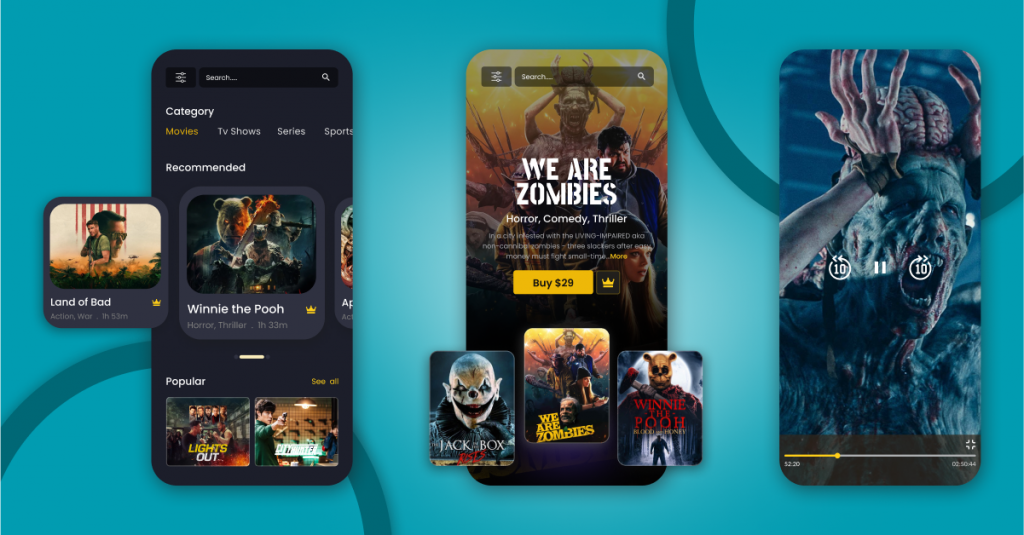
Over 60% of new streaming apps struggle to reach profitability within their first two years. The primary obstacle isn’t content quality or marketing budget; it’s the foundational decisions made when you create a movie streaming app. Choosing the wrong architecture, underestimating infrastructure costs, or misjudging platform priorities can lock you into insurmountable challenges.
The stakes are high in a market growing at 18.36% annually, projected to reach $599.20bn by 2033. Early technical decisions impact your ability to scale, retain users, and compete effectively.
This guide provides a framework for building a movie streaming application with the right technical foundation, one that delivers measurable value in a competitive landscape.
- Fully Customizable
- Lifetime Ownership
- On-Premise/On-Cloud
- 100% White-label
- Zero Revenue Share
- Hire Developers
What is a Movie Streaming App?
A movie streaming app is an on-demand movie platform that delivers video content directly to users over the internet, providing instant playback on any device. At its core, a movie streaming app functions as an OTT movie application, bypassing traditional cable or satellite distribution.
From a revenue standpoint, most movie streaming apps operate as subscription-based movie services, offering unlimited access to a content library for a recurring fee. Certain applications adopt hybrid models that combine subscriptions with advertising, rentals, or pay-per-view options to maximize reach and revenue.
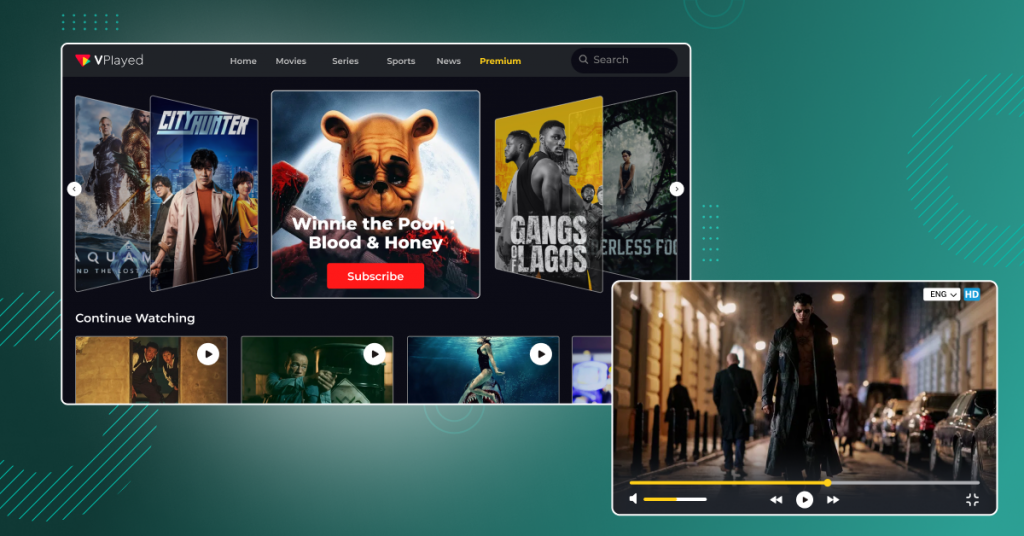
What separates a basic video player from a true movie streaming app is the ecosystem built around content delivery. This includes user authentication, personalized recommendations, adaptive streaming quality, content protection, analytics, and monetization workflows; all working together to deliver a seamless and scalable viewing experience.
Planning To Start a Movie Streaming Entertainment Business?
How to Create a Movie Streaming App? 7 Step Guide
Below is a simple, easy-to-understand version of the development process, ensuring each step incorporates the best practices for success.
1. Find Your Niche
2. Plan Your Content Strategy
3. Build a Revenue Model
4. Functionality and Tech Stack
5. Secure Your Movie Streaming App
6. App Testing & Launch
7. Promotion & Marketing
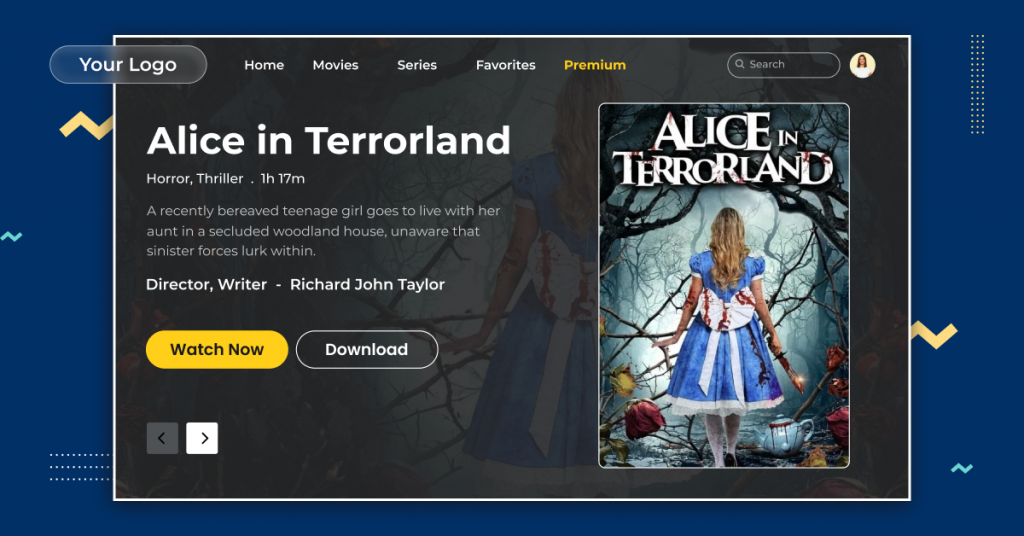
1. Find Your Niche
Finding a niche may seem unnecessary for a movie streaming app. Content owners often strive to build a subscription streaming service like Netflix, but often end up overgeneralizing the application, thereby struggling to compete in the crowded market.
In movie streaming context, a niche often means a specific audience, focused content library, and a clear USP that differentiates you from the rest. Remember, the goal should not be to replace Netflix (which is impractical, at best), but to offer an alternative.
Validate the Demand
Google Trends validates whether interest in the niche, genre, or viewing behavior is growing, stable, or declining over time. You can compare search trends across regions and timeframes. You can identify whether the demand for your niche is sustained or seasonal.
While trend data shows interest at scale, community discussions reveal why people care and what existing platforms fail to deliver. Reddit is the goldmine for unheeded community discussions. Recurring discussions about streaming quality, regional content, and a better search algorithm signal stronger opportunities.
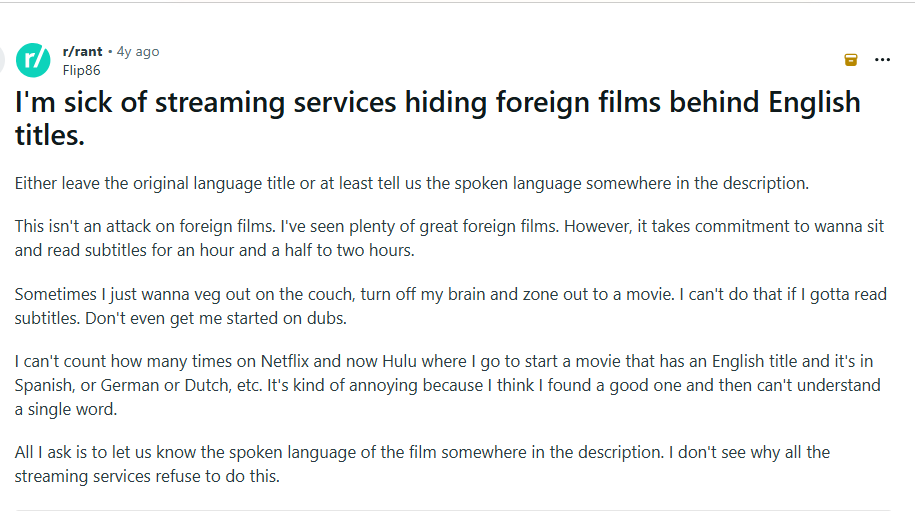
Reddit user expressing frustration with unclear spoken language details in movie listings
Repeated concerns like these reveal underserved expectations, reminding builders that niche opportunities often emerge from overlooked user experience details rather than major feature gaps.
2. Plan Your Content Strategy
Once your niche is set, the next critical step is deciding what content will power your streaming app. When you build a movie streaming app, content planning influences everything, from content licensing to organizing and infrastructure requirements to geographic expansion.
Movie streaming businesses often debate between licensing movies from third-party sources and producing original content. Licensing allows them to launch their movie streaming applications faster, whereas original production offers long-term content ownership.
Rather than opting for a standalone choice, many streaming services adopt a hybrid approach: acquiring content from production houses and investing in original productions. The right decision depends on budget, time-to-market, and the level of differentiation required at each stage of growth.
3. Build a Revenue Model
Monetization influences how your movie streaming app generates revenue, how viewers interact with the content, and how the app scales over time. Selecting the right model early helps align business goals with user expectations and avoids costly changes later.
Movie streaming apps make money in several ways:
* SVOD (Subscription Video on Demand): Subscription movie streaming generates recurring revenue (monthly, quarterly, or annually) for unlimited access to a content library.
Create a SVOD Platform That Scales
Build a feature-rich subscription video on demand platform with infrastructure designed for performance and monetization
* TVOD (Transactional Video on Demand): Pay per view movie streaming generates revenue per transaction for limited access to a content library.
* AVOD (Advertising Video on Demand): Ad-supported movie streaming generates revenue through ad inventories while offering free content for viewers.
Turn Your Streaming Vision Into Reality
Bring your streaming business to life with a AVOD Streaming platform built for flexibility, growth, and viewer engagement.
* Hybrid Approach: Free content access with ads (for certain playlists), while premium access and subscription (for exclusive playlists).
Remember: your first revenue model doesn’t have to be your forever model. Start with what makes sense today, validate it with real users, then evolve.
4. Functionality and Tech Stack
Professional movie streaming application is not a DIY project, where you feed from online video streaming providers, add descriptions through a public API, and stream. The goal shouldn’t be to build a basic application, but to build a feature-rich and secure platform with sophisticated functionalities and tech stacks.
Start the video player integration with play/pause controls, quality selector, volume, fullscreen toggle, subtitles, and progress bar. It’s also responsible for handling adaptive streaming, buffering management, and playback analytics.
Move on to the backend infrastructure, which manages user authentication, video content management system, access control mechanisms, payment processing, and serves your API to frontend applications.
Then, configure your APIs, which serve as a communication layer between your video player, mobile apps, and backend services. For example, the API generates a new reset token when a user resets the movie streaming app password. When they re-open the app, they have to log-in with a new password. API invalidates old sessions and validates the new password now.
The choice of APIs and SDKs may sound complex, especially if you’re a non-technical person. It is advisable to do extensive research or sit with your development team to decide.
3. Launch a Scalable Video Streaming Server
Want to create your own streaming infrastructure? Learn how to build your own video streaming server from the ground up.
5. Secure Your Movie Streaming App
Content piracy hinders revenue flow. Licensing disputes tarnish brand reputation. Vulnerable data security exposes sensitive user information. This leaves movie streaming apps liable to multiple stakeholders. For content owners and media production houses, overlooking security can turn a promising streaming platform into a legal and operational liability.
Getting Data Security Right
Strong data security ensures that user credentials, payment details, and viewing data are protected across devices and platforms. Implement measures like multi-factor authentication (MFA), stringent password requirements, and token-based session management to protect against unauthorized access.
Implementing Content Security
Content security protects your video assets from unauthorized downloads, sharing, and redistribution. Implement security protocols like digital rights management (DRM), AES encryption, geo-blocking, dynamic watermaking, and more. For content owners, if losing video content to piracy costs more than implementing DRM, then implement DRM.
6. App Testing & Launch
Testing is a crucial process before you launch the movie streaming app. Decision makers often overlook this phase (’we’ll fix bugs after launch’), which is exactly why many playback, delivery, and performance issues surface.
Thorough testing ensures reliable movie playback, smooth user flows, secure transactions, and stable performance under real-world conditions. A controlled, phased launch allows teams to validate assumptions, gather early feedback, and address issues before scaling. This sets the foundation for long-term stability, user trust, and growth.
Once the development process is clear, explore the best video streaming app builders built to support these requirements.
7. Promotion & Marketing
Building a movie streaming app is only half the battle; success depends on how well you promote it. To thrive in this bustling industry, the movie streaming app must stand out with a combination of strong branding, focused promotions, and effective customer engagement.
Here’s how you can devise marketing strategies:
Build a Calculated Pre-launch Buzz
Build anticipation before the movie streaming app hits the app stores. Use teaser campaigns, beta sign-up incentives, and exclusive access programs to build curiosity and a like-minded community around the platform. Network with industry leaders, nurture community discussions, and plan marketing campaigns to amplify awareness.
Go Hyperlocal (if it suits you!)
Hyperlocal marketing targets users in specific geographic areas with messaging tailored to their cultural context, language, and content preferences. For streaming apps serving niche audiences or regional content, hyperlocal strategies can deliver 3-5x higher conversion rates at a fraction of the cost of broad digital advertising.
Use Data and Optimize
Continuously track Key Performance Indicators (KPIs) such as Cost per Acquisition (CPA), Cost per Install (CPI), Lifetime Value (LTV), and user retention rates. Leverage insights-driven data to refine campaigns, ensuring resources are invested in the highest-return strategies. Additionally, implement A/B testing for creatives, CTAs, and promotions to ensure maximum ROI.
Ready to build your own Movie streaming platform Explore a solution built for faster deployment and scalability.


How Does Movie Streaming App Work?
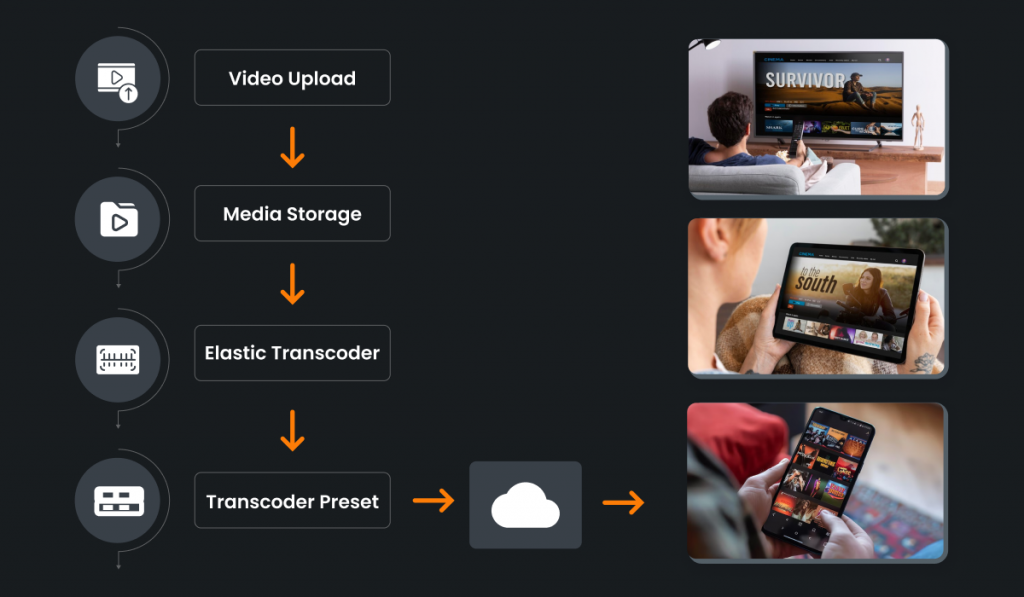
A movie streaming app functions through a series of interconnected processes that handle content ingestion, processing, storage, and delivery. All these processes happen in tandem to ensure smooth and reliable playback.
Behind the seamless playback experience lies a carefully orchestrated workflow, starting with:
1) Movie Upload and Processing: Fundamentally, a movie streaming app begins its journey with the movie upload workflow. Content owners, broadcasters, and production houses upload raw files to an online video platform, which prepares the files for streaming. Raw video files are converted into multiple formats and resolutions to support high-quality viewing on everything from smartphones to smart TVs.
2) Content Management: Streamable video files are securely stored either in cloud TV playout servers or on-premise servers. Now, the video files are organized based on the metadata such as titles, genres, thumbnails, and subtitles. This enhances the searchability of movies inside the video content management system for a swift playback and viewing experience.
Ready for the next step? Learn how to implement it effectively.
More details on the Content Management System that support successful platform development.
3) Playback and Delivery: When a user clicks play to access a movie, the app triggers the movie playback delivery process. Instead of sending the entire video file at once, the platform delivers the movie in small segments over the internet. The geographically distributed servers deliver the movie from a nearby centre to reduce buffering and latency.
4) Adaptive Movie Streaming: Movie streaming apps are equipped with adaptive bitrate capabilities, which automatically adjust the video in real-time. This ensures viewers get the best possible quality their connection can support, whether they’re on mobile data or high-speed Wi-Fi.
Explore the Core of Adaptive Movie Streaming
Before choosing a provider, understand what makes a adaptive movie streaming scalable and future-ready.
5) Analytics and Optimization: Behind the scenes, the movie streaming app continuously tracks performance metrics such as buffering events, playback errors, and viewer engagement. These insights help teams improve streaming reliability, optimize delivery, and refine the overall user experience over time.
Once you understand this workflow, building a movie streaming app takes the guesswork out of the equation and helps make informed, stage-appropriate decisions.
Ready for the next step? Learn how to implement it effectively.
A clearer understanding of video analytics fundamentals helps ensure a stronger implementation strategy.
What Are the Advantages of a Movie Streaming App?
Movie streaming apps offer unparalleled convenience, providing instant access to vast, on-demand libraries of movies and shows across multiple devices (smartphones, TVs, laptops) anytime, anywhere. Key advantages of building a movie streaming app include:
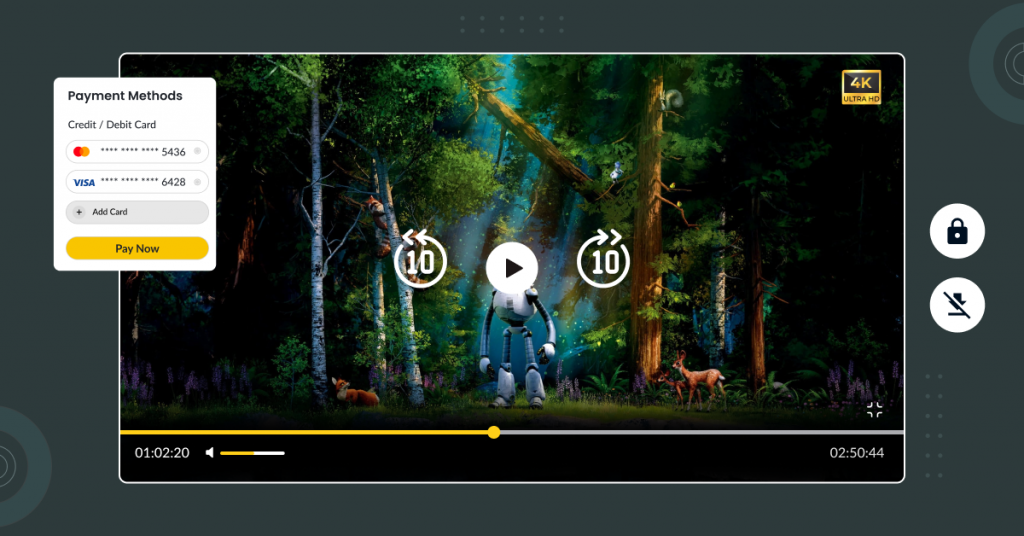
* Convenience and Flexibility: Movie buffs can access on-demand movies whenever it suits them. With anytime movie streaming across devices, users have the freedom to start, pause, and resume content on their own terms.
Massive Content Library & Originals: Building a movie streaming app with cloud transcoding allows you to accommodate massive content libraries under one roof. Originals and exclusive movie content offer a strong reason for users to subscribe, return frequently, and associate the platform with unique viewing experiences.
* Personalized Recommendations: Movie streaming apps boast a movie recommendation system that surfaces relevant content based on viewing history, preferences, and behavior. AI streaming-based movie suggestions refine recommendation choices over time.
* Multi-Device Support: Multi-device movie streaming enables viewers to seamlessly switch devices between smartphones, tablets, TVs, and web browsers. This flexibility allows them to enjoy movie streaming while their watch history is in sync, across devices.
* Offline Viewing: With offline movie downloads, viewers can continue watching during travel, in low-connectivity areas, or when conserving data. The ability to watch movies offline makes the streaming app more practical for everyday use and increases overall user satisfaction.
What Is the Cost to Create a Movie Streaming App?
Movie app development cost starts as low as $40,000 and can go up to $500,000. These applications are highly complex, involving numerous interconnected processes.
Content owners can either go for a white-label streaming app, which can range between $40,000 and $70,000, enabling a faster set-up and launch (in a few weeks). Or else, content owners can opt for custom development (from scratch), which usually consumes a lot of time and budget.
The exact cost and timeline can vary significantly based on a range of factors, including the number of features required, level of complexity, platform specifications, and more.
Create a Video Streaming App That Scales
Build a feature-rich Video Streaming App with infrastructure designed for performance and monetization
Conclusion
As you can see, building a movie streaming app is no small task, but if you plan it the right way, it becomes a simple process that can be implemented with minimal disruption.
We hope this blog puts your movie streaming app journey right on track, from identifying your niche to building a revenue model, securing your application, and testing and launching the app.
If you need any assistance or would like to leverage our extensive experience in building and user-friendly movie streaming applications, then feel free to reach out to us. You needn’t take our word for it; request a free demo today!
- Request Demo Book a Live, Personalized Demo
- Contact Sales Reach Out to Our OTT Experts
Frequently Asked Questions(FAQ):
1. How do I create a movie-streaming app?
Creating a movie-streaming app involves the following steps:
1. Planning the app’s features
2. Designing the user interface
3. Developing the app using programming languages
4. Integrating video streaming functionality and
5. Testing for performance and usability.
2. What are the benefits of developing a movie streaming app?
Developing a movie streaming app offers several benefits. For viewers, It allows users to access a vast library of movies and TV shows anytime, anywhere. For content creators, it provides a platform to showcase their work and reach a global audience. Additionally, it opens up revenue streams through subscriptions, advertisements, or pay-per-view models, contributing to business growth.
3. How much does it cost to build a movie streaming app?
Building a basic movie streaming app costs between $25,000 and $50,000. However, some high-end apps with sophisticated features may cost over $100,000. You can consult professional movie streaming app builders like VPlayed for accurate estimates.
4. How does a movie streaming app make money?
Movie streaming apps make money through various income streams such as subscriptions (SVOD), advertising (AVOD), pay-per-view (TVOD), coupons and promotions, sponsorships, and partnerships with content providers. Sometimes, they also make money by airing exclusive content to select audiences for a fee (Premium VOD).
5. What features should be considered when launching a movie streaming app?
When launching a movie streaming app, it’s essential to consider critical features. These include a user-friendly interface, a smooth video player, a multi-DRM solution, personalized recommendations, offline viewing, social sharing options, secure payment gateways, and seamless cross-platform compatibility.

Monika Gopinath is an accomplished digital marketer with over seven years of experience specializing in the VOD solution provider Industry. I am a passionate writer and avid blogger. I enjoy sharing insights on digital marketing, industry trends about VOD.




Hi, I’m looking for information on how to build a movie streaming website or app where viewers can pay for individual videos or live streams(SVOD or TVOD based). What would the price of this be? Do you provide an app in the package as well? Many Regards!
This article clearly explains the right strategy on how to make a movie streaming app and covers all the topics with solutions.
I’m considering launching a streaming platform. What’s the best strategy to build a movie streaming app that stands out from big players like Netflix and Hulu?
Thank you for this amazing guide! The step-by-step breakdown on how to create a movie streaming app is super helpful. Much appreciated!