Summarize this article in:


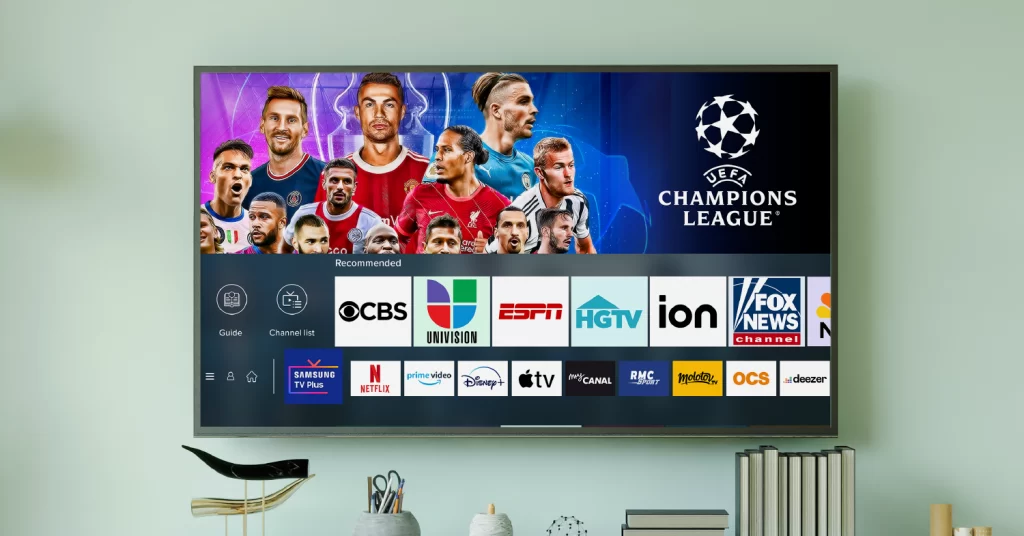
- FAST channels offer free ad-inserted content that is delivered over the internet without subscriptions.
- How it works: FAST channels broadcast pre-programmed 24/7 content through cloud playout using EPGs and CDNs, which resemble the classic channel-surfing experience.
- How It Makes Money: They are monetized through Server-Side Ad Insertion (SSAI) and real-time programmatic bidding
Here is a quick overview of FAST Channels and how they work:
FAST channels refer to Free Ad-Supported Streaming Television. They provide viewers with free video content through the internet and pay for this service with advertisements.
Cost-conscious consumers have begun to prefer no-cost entertainment, and as subscription fatigue sets in, the use of FAST channels will only continue to increase in 2026. In fact, FAST channel viewership grew by 21% in 2025, followed by a 27% rise in ad impressions, showing strong ad demand.
Even industry giants like Netflix are looking to implement continuous live TV channels in an effort to combat engagement loss, according to WSJ.
FAST channels provide consumers with access to free live news and sports and niche genre channels, filling the void created by the decline of traditional linear streaming and the pay TV trend.
This blog caters to media companies and independent content owners looking to launch a FAST channel. It details what is involved in the creation and maintenance of a FAST channel, benefits, key features, and how FAST channels monetize. Let’s begin.
- Fully Customizable
- Lifetime Ownership
- On-Premise/On-Cloud
- 100% White-label
- Zero Revenue Share
- Hire Developers
What are FAST Channels?
FAST stands for free ad-supported streaming TV, which is a type of online streaming service that delivers scheduled, linear television programming and on-demand content. FAST channels are free of charge and don’t charge any subscription fees, but monetize through scheduled ad breaks.
Think of it as traditional TV that is delivered over the internet directly to your viewers’ choice of device, such as connected TVs (CTVs), mobiles, and web browsers.
The key difference between on-demand AVOD services like Netflix or Hulu and FAST channels is that on-demand platforms let viewers pick any title to watch whenever they want, but FAST channels operate on a fixed broadcast schedule. You tune in to watch whatever is currently playing on that specific channel
Some FAST channels are Paramount’s Pluto TV and Tubi (owned by Fox), which provide an array of streaming TV channels, including a steady stream of news or crime drama loops.
Alternatively, hardware manufacturers integrate these linear channels into their operating system, such as The Roku Channel in Roku devices or LG Channels pre-installed in LG smart TVs. These allow viewers to watch and flip through channels with an EPG without having to pay.
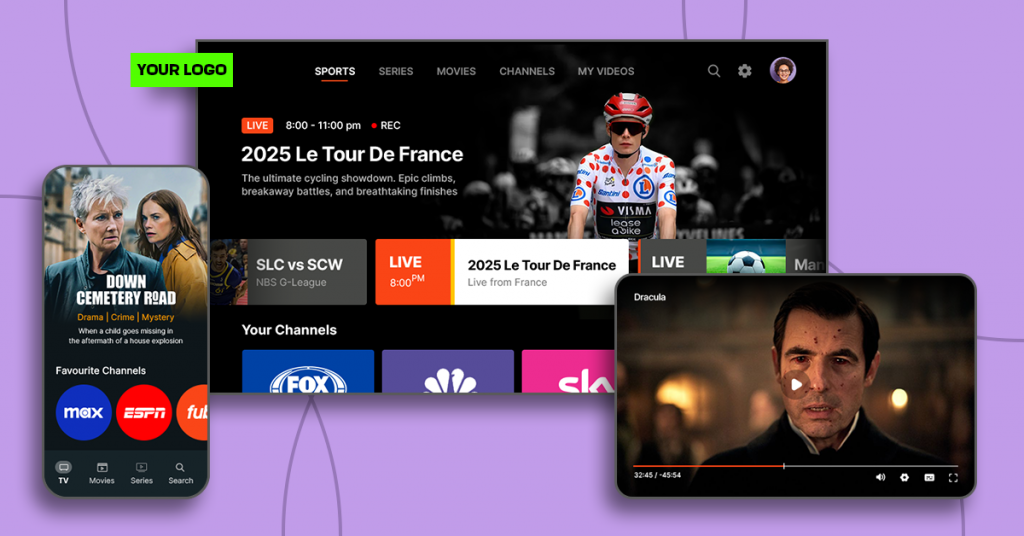
Want to Start Your Own Fast Channel Streaming Service?
How Does a FAST Channel Work?
FAST channel works similarly to the traditional format: ad-financed TV that requires no sign-up. Its process begins with the content owner curating the content, scheduling it, inserting ads, and delivering it across streaming devices. Here’s a closer look:
1. Content Curation and Preparation
The technical preparation and licensing necessary to deliver a broadcast-quality viewing experience are important to building a successful FAST channel.
- Content Curation
Form clusters within your media library based on specific themes like true-crime loops and sitcoms. This requires at least 168 to 200 hours of content to prevent any repetitive loops.
- Licensing
The usual standard Video-on-Demand (VOD Platform) rights aren’t sufficient for FAST channels. You’d need specific linear FAST distribution rights along with standard clearance. It has to map out revenue-share models such as ad-splits, flat-fee acquisitions, and minimum guarantees.
Media analysts like Alan Wolk state that FAST platforms allow curators to move beyond generic programming and offer dynamic content based on specific regions and viewer interest.
- Technical Preparation
Raw media files are uploaded to the FAST Channel streaming service provider that converts media into segmented video (HLS/DASH). This service provider takes care of automating playlists, transition graphics, and EPG automation.
Pro Tip: Easier said than done; however, it is worthwhile to try to negotiate live FAST and on-demand AVOD rights in a single deal. This lets your audience stream your 24/7 FAST channel while also monetizing on-demand content.
2. Channel Scheduling and Programming
Distinct programming strategies are needed to combat viewer churn. Since FAST channels rely on a 24/7 linear format rather than on-demand content, structuring the content in predictable blocks is important to keep the audience tuned in. Here is a simple programming guideline:
- Group by theme: Create a distinct programming block based on genre, era, language, host, sport, or topic by sorting media files accordingly.
- Sequence a day: Design a 24-hour broadcast schedule by fixing recurring blocks at certain daily times and filling low-audience times and overnight hours with deep archive content.
- Build reusable playlists: Ease the burden of daily programming by saving segments as templates (i.e., “Morning Workout” or “Classic Match Replay”) that you can later reuse and insert in other blocks you create.
- Loop and refresh: Run your automated schedule, but rotate titles weekly or monthly. Regularly refreshing your scheduled lineup is essential to keep audiences hooked. Outdated programming can quickly lead to audience churn.
A FAST Channel Readiness Checklist
| Phase | Strategy Pillar | Pre-Launch Validation Question |
| Target | Audience Definition | Can you define the niche appeal and your ideal viewer profile in one sentence? |
| Brand | Editorial Identity | Does your channel have a unique concept and an easily recognizable theme? |
| Legal | Rights Verification | Does your distribution agreement support specifically for linear FAST channel? |
| Volume | Catalog Depth | Do you have sufficient content to run a 24/7 continuous stream without frequent repetition? |
| Grid | Programming Blocks | Do you have recurring named blocks, regular predictable shows, and fillers? |
| Events | Tentpole Marathons | What are some thematic programs or weekend marathon programming that you have to spike viewership? |
| Rotation | Schedule Refresh | What is your plan to rotate the schedule to prevent churn? |
| Playout | Technical Execution | Have you ensured that your ad insertion markers and transition assets are free of timing glitches? |
The Takeaway: If you answered all eight questions with definitive answers, you have a viable content strategy. If you couldn’t, then you need to revisit your catalog and create a strong programming grid before launching a live broadcast.
3. Ad Insertion and Delivery
Monetizing 24/7 linear streams requires advanced advertising workflows capable of integrating digital and traditional broadcast ad infrastructure.
The Free Ad-Supported Streaming TV market is expected to grow from $11.5 billion in 2026 to $40.2 billion by 2033, making effective and efficient ad inventory critical to maximize potential.
| Workflow Stage | Technology/ Process | Description |
| Preparation | Transcoding & Encoding and SCTE Markers | Files get converted to adaptive bitrate (HLS/DASH), and SCTE-35 digital signaling markers are inserted to specify the exact positions of breaks in the stream. |
| Triggering | Ad Request and Targeting | When the playout server hits an SCTE marker, it sends a request with user telemetry (device, location, demographics) to ad servers. |
| Valuation | Real-time bidding (RTB) | Programmatic auctions happen in milliseconds to allow multiple parties to bid on the ad inventory. |
| Execution | Ad Decisioning | The ad server decides on the best creative based on yield optimization and target criteria. |
| Delivery | CSAI vs SSAI(Server-Side Ad Insertion vs. Client-Side Ad Insertion) | SSAI integrates ad content into the video stream on the server to ensure ad integration and avoid ad blockers. CSAI relies on the client device to download and integrate ad content, which results in long playback delays. |
4. Distribution Across Streaming Devices
Converting current library content to a 24/7 live stream is the first step in bringing a high-quality broadcast experience to internet users.
- Industry Data & Insight:
The overall viewing hours on the major FAST services increased by 43% year-over-year, with connected TV (CTV) homes increasingly seeing free linear apps as a direct cable alternative. (Source: Comscore 2025 State of Streaming Report)
How it Works:
- Transcoding: Raw media content and playlist timetables are converted to adaptive bitrates, so that users can get the best resolution for their internet connection.
- HLS or DASH: The continuous stream is encoded in common streaming formats such as HLS (HTTP Live Streaming) or DASH (Dynamic Adaptive Streaming over HTTP) to ensure smooth streaming on various devices.
- Content Delivery Networks (CDNs): CDNs are high-performance networks that store and serve video manifests and segment chunks around the world, avoiding buffering and traffic load spikes during peak viewing time.
- Platform Delivery: The final stream and EPG metadata are delivered via platform delivery pipelines to major Connected TV ecosystems (e.g., Samsung TV Plus, Roku, and LG Channels), or owned and operated Web and mobile apps.


5. Data-Driven Advertising and Personalization
As opposed to traditional broadcast cable, FAST channels are internet-delivered, which allows for a degree of audience targeting that old-fashioned TV broadcasting cannot hope to match.
Advertisers don’t have to pay for the city-wide ad slot anymore; they can use digital user data to reach the exact demographics, household types, and geographic areas – down to the neighborhood level.
Highlighting this exact shift, media analyst Alan Wolk notes:
“Because FAST is digital, you have so much data about who’s watching, where, when, and all that, and so they’re able to personalize the advertising based on audience segmentation. If I want to reach a certain demo, I can reach them. Geolocation gets very specific.”
This gives your ad inventory so much more value that channel owners can now ask for higher CPMs (Cost Per Thousand Impressions), as brands know that their ads are reaching the correct target audience with no wasted spend.
How Do FAST Channels Make Money?
The primary revenue model for FAST channels is ad insertion, such as SSAI, revenue share, or programmatic advertising. The monetization potential varies depending on the genre. News and business categories have higher advertiser demand than lifestyle or evergreen entertainment due to audience targeting.
- Server-Side Ad Insertion (SSAI): SSAI is where ads are inserted into the master cloud video stream on the server-side, as opposed to having to go to the client device and download them there. This approach works around ad blockers and ensures that there is no buffering, providing a TV-like experience during commercial breaks.
- The Revenue Split: Using major distribution platforms (i.e., Roku and Tubi) requires entering into a revenue-share agreement. The platforms manage ad sales and technology and sell the ad inventory, keeping a significant portion for themselves while allowing the channel owner a smaller portion (typically a 40% to 60% royalty structure).
- Programmatic Advertising: The telemetry of individual viewers and associated demographic information is used to determine ad campaigns in real time and during every scheduled commercial break. The commercial inventory is sold via automated, real-time bidding.
Must-Have Features of a Fast Channel
To create a successful FAST streaming service that delivers a TV-like experience, you need infrastructure that supports a 24/7 linear programming structure, SSAI, and a robust video CMS. Here’s a list of key core technical, content, and business features.
1. Channel Creation and Customization
This should let you create your unique editorial identity and format content into an automated 24/7 linear programming grid. It is better to opt for a white-label streaming platform that lets you customize the UI for your niche to build brand authority from the outset.
2. Video Content Management System
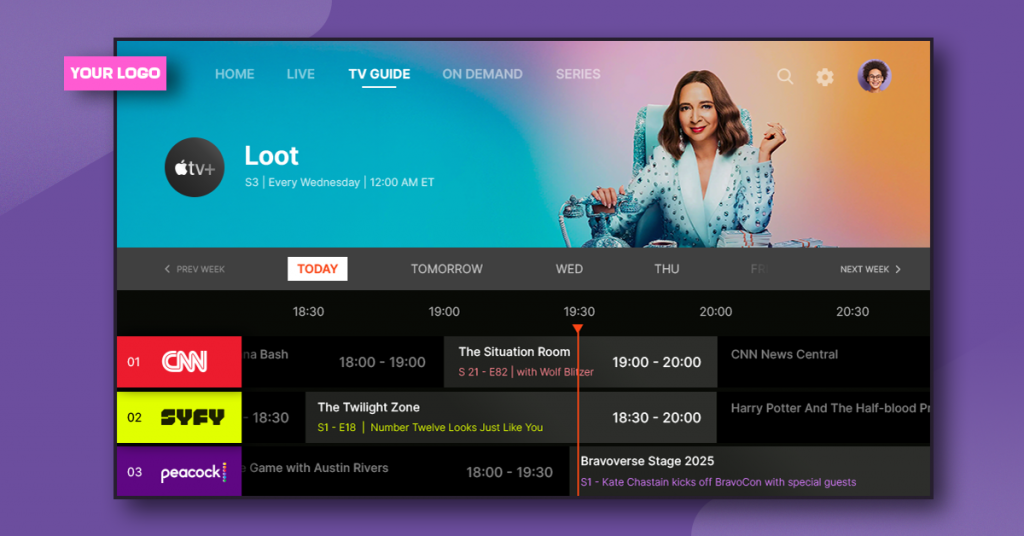
Every FAST streaming channel needs a cloud-based playout with a video CMS or video asset management (VAM). This helps ingest, tag, and organize content, which in turn helps with easy search and discoverability. A video CMS also powers an Electronic Program Guide (EPG) to resemble traditional channel-surfing guides.
It is a vital component in FAST channel streaming. According to Growth Market Reports, the EPG market is projected to reach $2.97 billion by 2033 as viewers increasingly rely on program guides to navigate live linear streams.
3. Server-Side Ad Insertion (SSAI)
SSAI means stitching targeted digital ads directly into the FAST TV stream, preventing any buffering and bypassing client-side ad blocking. Helps maximize ad fill rates and secure predictable monetization.
4. Multiple Monetization Options
Along with SSAI in linear streams, you could have an AVOD library. This will allow viewers to browse through the catalog to find anything from live to VOD archives. It is better to have multiple video monetization models for extended engagement and monetization.
5. Multi-Device and CTV Distribution
Your FAST channel should obviously support multi-platform distribution across mobile, web, and Connected TV (CTV) environments. This ensures maximum viewer reach by capturing them on whichever device they consume content from, increasing total ad impressions.
6. Adaptive Bitrate Streaming
Your FAST channel must dynamically adjust the video quality to match the viewer’s network conditions across different devices. It helps keep buffering at bay and user drop-offs due to poor connectivity.
7. DRM and Video Content Protection
DRM keeps premium media assets protected from unauthorized downloading or stream ripping. Ultimately, this protects your content licensing contracts and maintains the exclusivity of your media library.
8. Content Discovery and Recommendations
Integrates rich metadata to help provide accurate search results and suggest personalized content. This, in turn, increases engagement and improves watch time.
9. Real-Time Analytics and Reporting
You need real-time analytics to keep track of viewer engagement, drop-off rates, and ad impressions. This will help you optimize channel performance and programming strategies in the long run.
10. Scalable CDN-Based Video Delivery
A high-performance, global Content Delivery Network (CDN) handles massive traffic spikes during peak viewing times. Guarantees broadcast quality and reliability during high-demand live streaming programs.
What Are the Benefits of FAST Channels?
FAST TV streaming offers benefits for viewers, advertisers, and content creators. Here are the benefits of FAST channel streaming:
- Free Access for Viewers: By providing ad-inserted content for free with zero subscription fees, FAST channels eliminate financial barriers. This helps attract cost-conscious viewers who want to avoid rising streaming costs.
- Additional Revenue From Advertising: Rather than just relying on SSAI targeted commercial spots in free ad-inserted content, content owners can use AVOD (Advertising-Based Video on Demand) monetization with their VOD content.
- Wider Content Distribution: Deploying a FAST channel with fully owned custom-branded apps across web apps, mobile applications, and Smart TV ecosystems gives a global audience reach without having to rely on rigid third-party platforms.
- TV-Like Viewing Experience: FAST TV channels use scheduled programming streams just like classic TV. They use an automated electronic guide to offer a lean-back experience that combats subscription fatigue.
- Opportunities to Repurpose Existing Content: This is considered a lucrative second-life engine for legacy video libraries and niche genres. It gives new life to these media assets with automated linear television broadcasting schedules.
Wrapping Up
We just saw what a FAST channel is and how it works. It is one of the smartest ways to turn your library into a channel that performs. It is a cozy online streaming version of traditional Cable/Satellite TV.
It doesn’t matter if you’re looking to repurpose an existing catalog or build a brand-new niche experience; you need a strong technical foundation. One such FAST channel streaming platform provider is VPlayed. You get:
- Cloud playout and automated scheduling
- Server-Side Ad Insertion (SSAI) to maximize ad fill rates
- Multi-platform distribution across CTV, mobile, and web apps
- Electronic Program Guide (EPG) integration for classic channel-surfing
- Scalable Content Delivery Network (CDN) integration
- Adaptive bitrate streaming and real-time analytics
When you combine smart content curation with SSAI and robust delivery, you give viewers the lean-back, comfortable feel of traditional broadcasting. And you, as a content owner, get modern digital monetization.
It is exactly this quality, being the best of both worlds, that has made FAST TV channels popular. Whether you are an independent creator or content owner with a growing niche library or a well-established media broadcaster looking to draw in cord-cutters and cost-conscious viewers, launching a FAST channel is the next natural move.
Request a demo to see how VPlayed can turn your video library into a fully functional FAST channel today.
- Request Demo Book a Live, Personalized Demo
- Contact Sales Reach Out to Our OTT Experts
Frequently Asked Questions (FAQ):
1. What is a FAST Channel?
A FAST (Free Ad-Supported Television) Channel is an online streaming service that offers free content to viewers, supported by advertising. These channels provide a wide range of programming, from movies to live events, at no cost to the audience.
2. How do FAST Channel Platforms Make Money?
FAST channel platforms make money primarily through advertising. Advertisers pay channel owners to showcase their products or services to the channel’s viewers. And, this advertising income sustains the free content offered to the audience.
3. What are the Features of FAST Channels Streaming?
FAST channels offer on-demand content, live TV, and a variety of genres. They often include ad-supported streaming, diverse content libraries, and accessibility on various devices.
4. How Does a Fast Channel Differ From Traditional Conventional Channels?
FAST Channels are delivered over the internet, while a conventional TV channel delivers content over satellite signals. FAST channels also offer a more flexible and convenient viewing experience. Unlike traditional TV, which often requires cable subscriptions, FAST channels are typically free and supported by ads.
5. How to Launch Your Fast Channel Streaming?
To launch a FAST channel, you must acquire content rights, a platform to host and stream content, ad partnerships, and a vibrant marketing strategy. Additionally, you must ensure compatibility with popular streaming devices and apps if you’re targeting a broader audience.

Senior Analyst specializing in Online video platforms, OTT, VOD, and white label video streaming solutions. Expert in analyzing industry trends, technologies, and monetization strategies to help businesses optimize their streaming services. Passionate about innovation and the evolving digital video landscape.