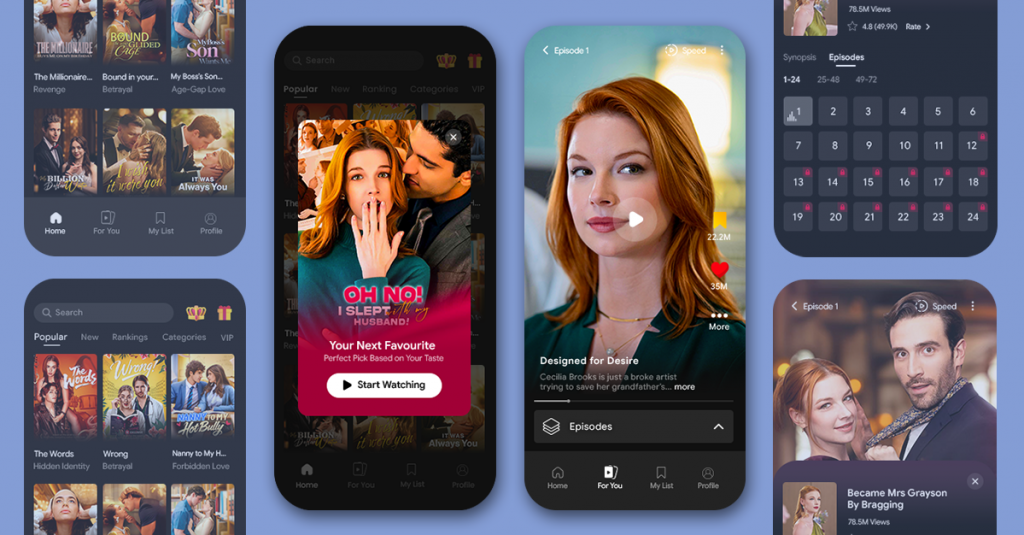
Long-form content still has its place. But attention? That has officially gone short-form.
Microdrama apps are emerging right at the intersection of shrinking attention spans, mobile-first viewing, and binge-worthy storytelling.
These platforms are serving up tightly scripted episodes which are usually 60 seconds to 10 minutes long. The kind that grabs you from the get-go and leaves you thinking “just one more episode” and guess what it is working quite well.
What is fueling this surge is not just convenience, but format innovation. For businesses, this combination translates into higher completion rates, repeat usage, and numerous ways to monetize content via subscriptions, pay-per-episode, ads, or hybrid models.
For content studios, media startups & OTT entrepreneurs, microdrama apps open up a whole new route: faster launches, leaner content production and a chance to make a profit from storytelling without the massive overheads that come with producing long-form content.
In this guide, we will break down what a microdrama app is, why they are growing in popularity so fast and how you can build a microdrama app with the right tools and strategy in place.
- Fully Customizable
- Lifetime Ownership
- On-Premise/On-Cloud
- 100% White-label
- Zero Revenue Share
- Hire Developers
What Is a Microdrama App?
A microdrama app is a mobile-first streaming platform built for short-form, scripted videos delivered in 1-2 minute chunks that keep audiences coming back for more.
In fact, market leaders like ReelShort, DramaBox, ShortMax, and PineDrama are already clocking up impressive daily engagement numbers.
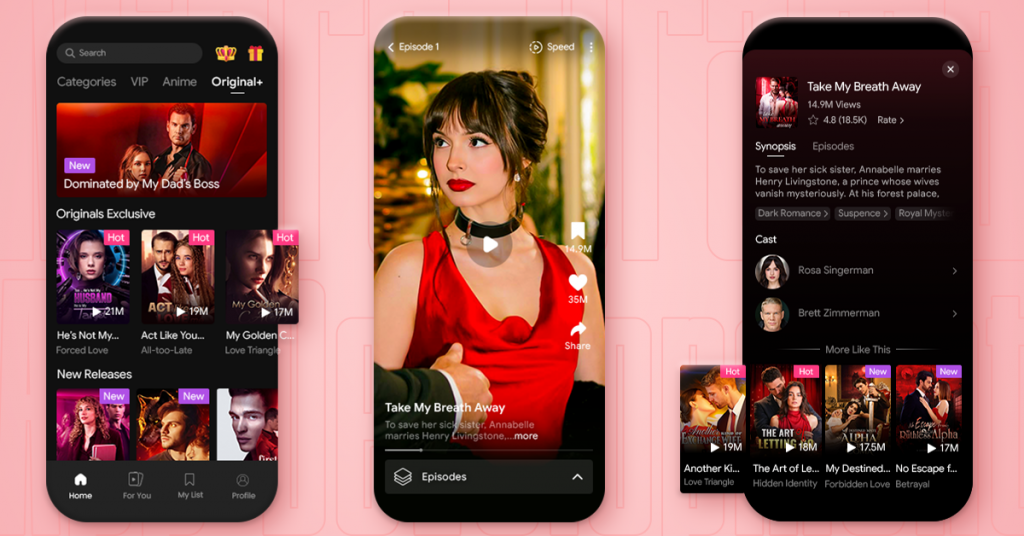
But what exactly makes these apps so successful? They are built around vertical-format episodic stories that are usually released all at once or drip-fed in daily batches to maximize retention.
Each episode will end with a cliffhanger, a hook or some other emotional scene that will get you wanting to watch the next one right away.
From a product standpoint, microdrama apps occupy the middle ground between the OTT platforms and short video platform. But with one difference: they monetize scripted content.
Here, you may have a question – Are microdrama apps different from short video apps?
Short-video apps are discovery-driven and creator-led. A microdrama app, on the other hand, is content-led and narrative-driven. The platform owns or licenses the stories, controls release schedules, and directly monetizes access.
That is why microdrama app development requires a different backend compared to social video apps, especially when it comes to content management, episode gating, payments, and analytics.
Benefits of Creating a Microdrama App
Microdrama platforms come with a number of benefits that traditional OTT apps, long-form video streaming platforms, and even social video apps struggle to deliver at scale. In this section, let us break down why launching a microdrama app makes strong business sense today.
1. Built for How Audiences Actually Watch Content Today
Attention spans are shorter, but appetite for storytelling has not disappeared. It has simply changed shape. Users are no longer committing to 45-minute episodes by default. Instead, they are watching content in:
- 2–5 minute bursts
- Between commutes, meetings, and daily tasks
- On mobile devices, often with one hand
A micro drama app is designed exactly for this behavior. Episodes are short, tightly written, and optimized for vertical or mobile viewing. This format encourages:
- Higher completion rates per episode
- Faster binge cycles
- More frequent daily engagement
From a platform perspective, this translates into more sessions per user. And that is a powerful metric when you are thinking about retention, monetization, and lifetime customer value.
2. Faster Content Production & Quicker Returns
One of the biggest advantages of microdrama app development is the speed-to-content ratio.
Traditional OTT content requires:
- Large production budgets
- Long filming schedules
- Months before monetization begins
Microdramas flip that model:
- Lower production costs per title
- Quicker release schedules
- Rapid audience feedback loops
This allows platforms to test storylines, genres, and formats without betting everything on a single high-risk production. Content that performs well can be extended. Content that does not can be quietly phased out.
For businesses, this creates a lean content strategy where experimentation is affordable and iteration is fast. If your goal is to create a microdrama app that scales sustainably, this production efficiency is a major advantage.
3. Monetization That Matches Viewer Psychology
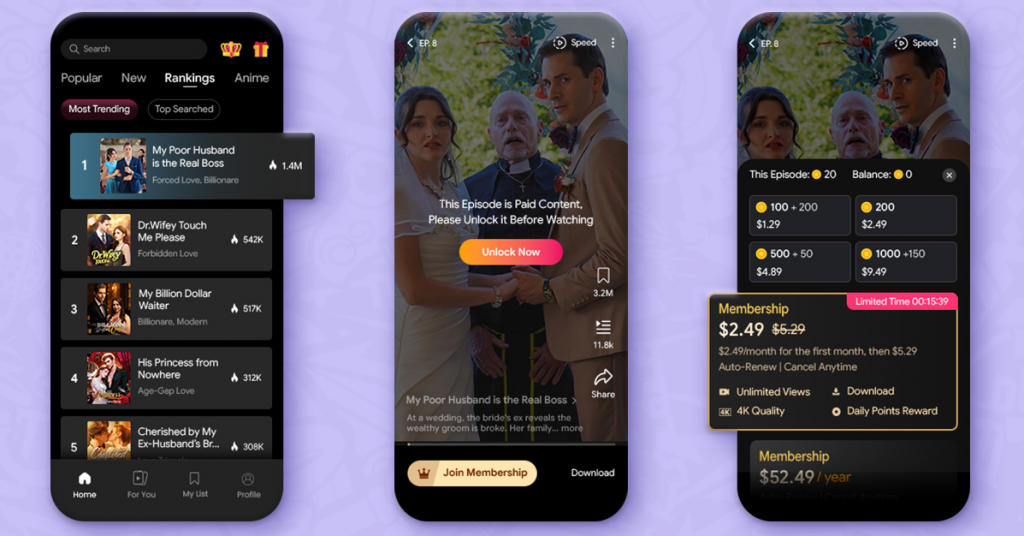
Microdrama streaming apps come with monetization models that feel natural to the format.
Instead of relying only on monthly subscriptions, platforms can experiment with:
- Episode-based or season-based access
- Microtransactions for priority playback
- Pay-per-view for premium story arcs
- Ad-supported viewing for free users
- Hybrid models combining ads and payments
Short episodes reduce friction around payment decisions. Paying a small amount to view the next episode feels easier than committing to a full subscription upfront.
This is why many successful microdrama platforms see:
- Higher conversion rates from free to paid users
- Strong impulse-driven purchases
- Better monetization per minute watched
4. Stronger Retention Through Episodic Hooks
When it comes to microdrama, each episode is written to end with a moment that pushes the viewer to watch “just one more.” This storytelling technique is not new, but in a microdrama app, it becomes extremely powerful because the time commitment is so low.
From a business standpoint, this creates:
- Higher episode-to-episode retention
- Strong daily return rates
- Predictable engagement patterns
Instead of users binge-watching an entire season in one night and disappearing, microdrama platforms often see repeat daily usage. That consistency is gold when you are measuring:
- Ad impressions
- Purchase opportunities
- Recommendation effectiveness
5. Mobile-First Reach With Global Scalability
Microdrama apps are inherently global. Because episodes are short and mobile-optimized, they:
- Load faster on variable networks
- Consume less data per session
- Perform well in mobile-first markets
This makes it easier to expand into regions where:
- Smartphones are the primary screen
- Long-form streaming is expensive or impractical
- Viewers prefer snackable content
Subtitles, dubbing, and localized storylines can be rolled out incrementally, allowing platforms to test international markets without heavy upfront investment.
If your long-term plan is to build a microdrama app with global reach, this format removes many of the technical and behavioral barriers that traditional OTT platform face.
6. Better Data + Informed Content Decisions
A micro drama streaming app generates a high volume of interaction data.
Because users are constantly:
- Starting episodes
- Completing episodes
- Dropping off mid-story
- Subscribing to premium content
You gain granular insights into what works and what does not.
This data helps:
- Refine storytelling structures
- Optimize episode length
- Adjust monetization placement
- Personalize recommendations
Instead of waiting weeks to evaluate a season’s performance, microdrama apps can analyze success in near real time. For content-led businesses, this feedback loop is a huge advantage.
7. Strong Brand Differentiation in a Crowded Market
No doubt, the OTT market is crowded, but microdrama apps still offer room for differentiation.
Most mainstream platforms compete on:
- Big-budget originals
- Licensing wars
- Celebrity-driven content
Microdrama apps compete on:
- Story speed
- Emotional hooks
- Mobile-native experiences
This opens the door for niche storytelling, experimental formats, and creator-driven narratives that might never survive on traditional platforms. If your goal is to launch a microdrama app that stands out rather than blends in, this format gives you creative and strategic flexibility.
Looking To Build Your Own Microdrama App
Start and Grow Your Microdrama App With 1000+ Features & 10+ Revenue Models.
 Highly Customizable
-
Life Time Ownership
-
Own 100% of Your Revenue
-
Full-Branding Freedom
 Highly Customizable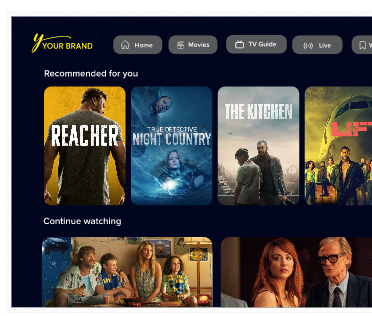
Build Your Microdrama App with VPlayed: A 6-Step Guide
Once the opportunity is clear, the next question is execution. How do you actually build a microdrama app that can handle fast content cycles, short-form engagement, and different types of monetization models?
This is where platforms like VPlayed come into the picture. Instead of stitching together multiple tools or betting everything on custom development, you get a structured, OTT-ready foundation that is already built for content owners and video-first businesses.
Here is a step-by-step breakdown of how to build a microdrama app using VPlayed in 2026.
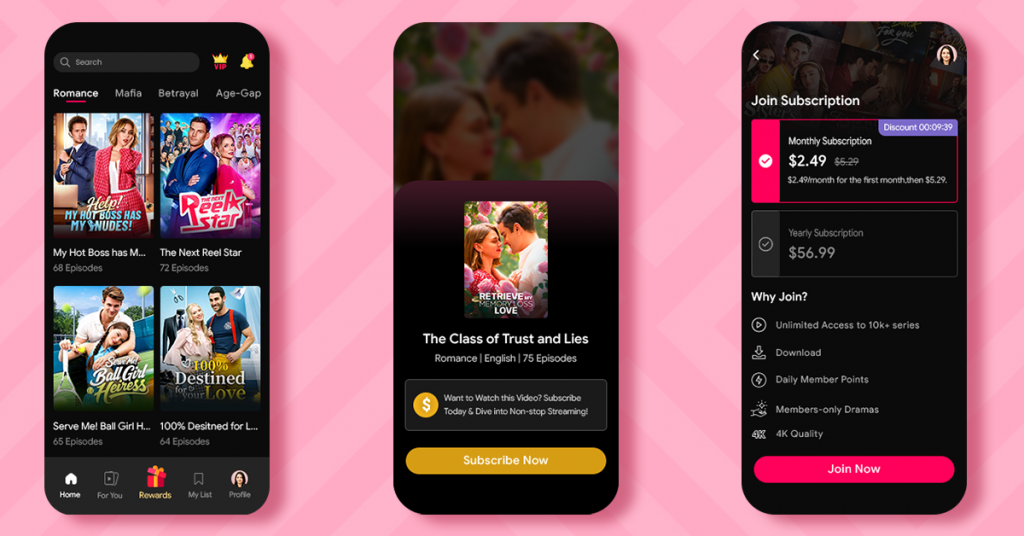
Step 1: Define Your Microdrama Content Strategy
Before technology, clarity matters the most.
Microdrama apps succeed when content is intentional. Not some random short videos stitched together. At this stage, you need to lock down:
- Episode length (typically 1- 3 minutes)
- Story structure (cliffhangers, multi-arc narratives, genre focus)
- Target audience (Gen Z, mobile-first viewers, regional audiences)
This is also where you decide whether your micro drama app will be:
- Creator-driven
- Studio-led with exclusive IP
- Genre-focused (romance, thrillers, drama)
Step 2: Choose the Right Monetization Model
Microdrama apps work best with hybrid monetization, and this decision should be decided early.
With VPlayed, you can configure multiple video monetization layers such as:
- Free episodes with ads
- Pay-per-view or pay-per-episode
- Early-access passes for engaged viewers
- Bundled season pricing
The key advantage is control. You are not locked into one revenue model. As viewing behavior changes, you can tweak pricing, access rules, and offers without rebuilding the app. This flexibility is important when you create a microdrama app to scale beyond early adopters.
Step 3: Set Up the Microdrama App Architecture
A microdrama streaming app may look simple on the surface, but the backend needs to handle quick user response without any technical glitch.
With VPlayed, this step includes:
- Video hosting and adaptive streaming
- A video CMS for managing episodes, metadata, and series order
- CDN-backed delivery for fast global playback
- Device-ready architecture for mobile, web, and Smart TVs
Since microdramas rely on frequent episode drops, the CMS becomes a core operational tool. VPlayed’s video content management system allows teams to:
- Upload episodes in bulk
- Schedule releases
- Organize content by series or season
- Make quick updates without developer dependency
Step 4: Design a Mobile-First User Experience
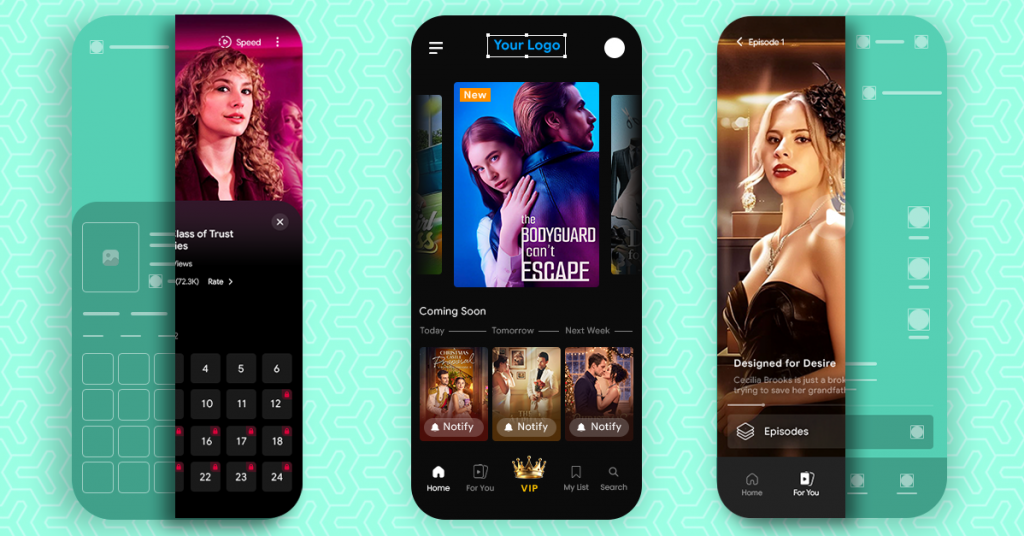
Microdrama consumption is overwhelmingly mobile-first. Your app experience should reflect that reality. Using VPlayed, you can:
- Customize the UI to support vertical or short-form layouts
- Design binge-friendly episode flows
- Highlight “continue watching” and next-episode prompts
- Integrate smart recommendations based on viewing behavior
All in all, when users open your microdrama app, they should be watching within seconds. Fewer clicks. Faster playback. Clear progression through episodes. VPlayed’s white-label customization makes it easier to design this experience without being boxed into rigid templates.
Step 5: Secure Your Content and Control Access
Short-form does not mean low value. In fact, microdrama content is often more vulnerable to piracy because of its easy shareability.
VPlayed helps you protect your microdrama app with:
- Multi-DRM support
- AES encryption
- Secure playback URLs
- Geo-restrictions and access rules
This ensures that:
- Paid episodes stay paid
- Early-access content remains exclusive
- Your IP is protected across devices
Step 6: Launch, Analyze, and Optimize Continuously
Launching the app is not the finish line. It is the feedback loop.
With VPlayed’s built-in analytics, you can track:
- Episode completion rates
- Drop-off points in a few clicks
- Monetization performance per series
- User retention and engagement patterns
These insights help you:
- Refine episode length
- Improve storytelling hooks
- Adjust monetization placement
- Decide which stories deserve expansion
Because microdramas move fast, your platform needs to support fast decisions. VPlayed’s analytics gives you the visibility required to iterate without any guesswork.
Cost to Develop a Microdrama App in 2026
The cost to develop a microdrama app depends largely on how you build it and how fast you want to launch. There is no fixed price, but most businesses choose between two practical routes: using a ready-made video streaming platform or building everything from scratch.
Let us break both down clearly.
1. Using a Video Streaming Platform
This is the fastest and most cost-effective approach for launching a microdrama streaming app in 2026. Crucial things like video hosting, CMS, DRM, analytics, and multi-device support are all sorted so you don’t have to start from the foundation.
Typical cost range – Approximate Values
- Initial setup & customization: $25,000 – $60,000+
- Ongoing platform costs: $1,000 – $4,000 per month
This route works well if you want to:
- Validate the micro drama app concept fast
- Launch multiple shows quickly
- Experiment with monetization models
- Expand operations without hiring a large tech team
2. Custom Development From Scratch
Building a microdrama app entirely from scratch involves developing backend systems, video streaming infrastructure, mobile apps, security layers, and ongoing maintenance.
Typical cost range – Approximate Values
- Initial development: $120,000 – $300,000+
- Timeline: 6 – 12 month + ongoing maintenance costs
This approach usually makes sense only if:
- You have very unique technical requirements
- You already run a large engineering team
- You are building proprietary technology as a core asset
What makes more sense for content/business owners?
A platform-based approach. Why? Because it offers the best balance between cost, control, and time-to-market. Custom development can come later, once the business model is proven.
Wrapping Up
We can conclude by saying, when you build a microdrama app, you are essentially tapping into a format that was designed and built to be addictive.
Episodes that leave you right on the edge of your seat, a storyline that makes you want to come back every day, and monetization models that turn attention into revenue way quicker than traditional formats.
Of course, having a good strategy is just as vital as getting the execution right. A well thought out content plan, a clear idea of how you are going to make money from it all, and the right tech behind it can make all the difference.
When done right, microdrama apps can reach far beyond casual viewership. They can become sticky digital destinations that audiences treat as their daily dose of entertainment.
- Request Demo Book a Live, Personalized Demo
- Contact Sales Reach Out to Our OTT Experts

Blogger & OTT Expert at VPlayed. Interested in digging deep into video streaming media tools, blog, discuss and share views on the legal OTT solution' & latest technologies tips, and tricks. Also passionate about photography loves to capture the pure essence of life.