Summarize this article in:


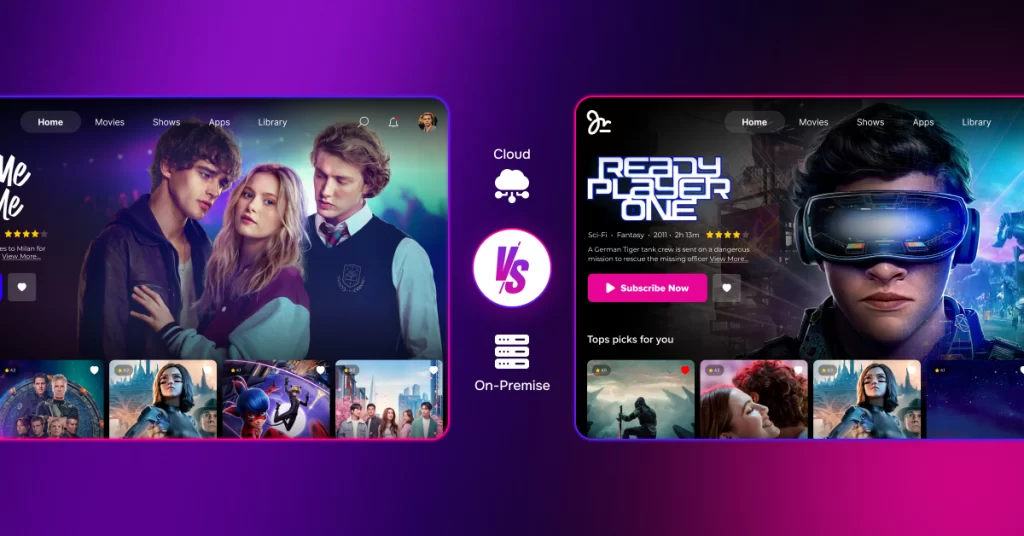
Launching an OTT platform has become highly commoditized. Scaling it without infrastructure problems? That is where things get interesting.
Most video streaming businesses focus heavily on content, apps and monetization in the early stages. Fair enough. But infrastructure decisions quietly decide everything that comes after it, including scalability, buffering, platform performance, security, and long-term operational costs.
This is exactly where many OTT businesses hit the threshold limit.
Some choose cloud-based OTT platforms for speed and flexibility. Others prefer on-premise OTT platforms for deeper control and ownership. The challenge is not choosing what is popular. It is choosing what actually fits your video streaming business.
Because the wrong infrastructure setup may work fine when you have 1,000 users. Things change very quickly when that number becomes 100,000.
This is why the cloud vs on-premise OTT debate matters a lot in 2026.
In this blog, we break down:
- What cloud and on-premise OTT platforms mean
- The pros, limitations, and business impact of each approach
- Key differences across cost, scalability, customization, and security
- How to choose the right OTT infrastructure for your video streaming goals
Because in streaming, infrastructure is not just a backend decision anymore. It directly affects how far your OTT platform can grow in years to come.
- Fully Customizable
- Lifetime Ownership
- On-Premise/On-Cloud
- 100% White-label
- Zero Revenue Share
- Hire Developers
Understanding OTT Infrastructure & Why It Matters
OTT infrastructure is the foundation that enables everything behind the scenes. Spanning video storage and transcoding to streaming delivery, user management, content security, monetization workflows, and platform performance, all of it depends on the infrastructure you choose.
And when the infrastructure is not built properly, viewers notice it immediately.
Buffering during peak traffic. Slow app performance. Playback failures during live streaming. Sudden downtime when user traffic spikes. These are not just technical issues, they directly affect user retention, engagement, and revenue.
That is why infrastructure decisions are business decisions.
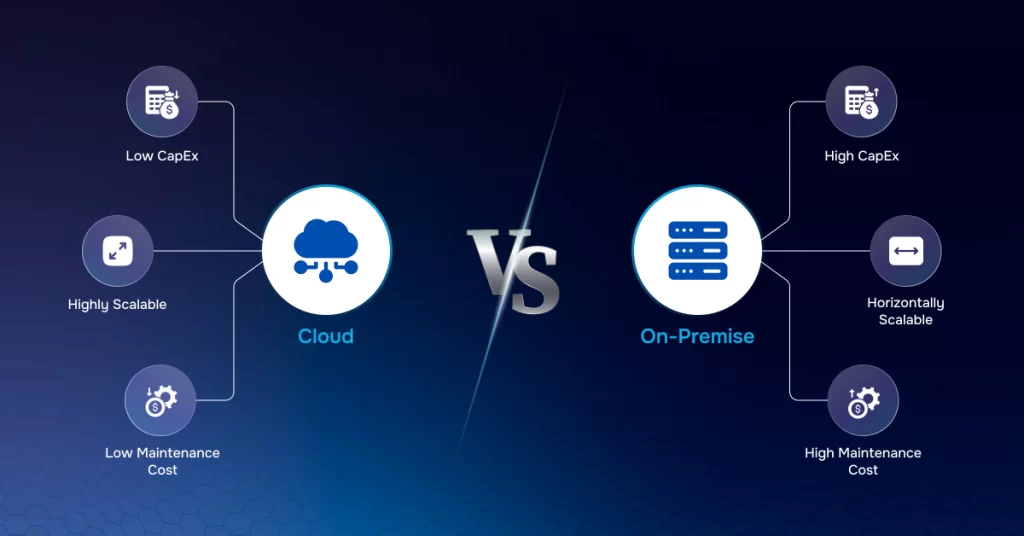
A cloud-based OTT platform and an on-premise OTT platform may deliver the same content to users, but the way they handle scalability, maintenance, security and operational control is completely different.
For example, cloud infrastructure allows streaming businesses to scale quickly without investing heavily in physical servers. On the other hand, on-premise infrastructure gives businesses deeper control over data, customization, and platform environments.
Neither approach is universally “better.”
It depends on:
- How fast your platform is growing
- How much control you need
- Your security and compliance requirements
- Your internal technical capabilities
- How you plan to monetize and scale over time
This is where the cloud vs on-premise discussion becomes important. Because choosing the wrong OTT infrastructure early on can create limitations that become very expensive to fix later.
What Is a Cloud-Based OTT Platform?
A cloud-based OTT platform is hosted and managed on third-party cloud infrastructure instead of physical servers owned by the streaming business itself.
In simple terms, your OTT platform runs on cloud environments like AWS, Google Cloud, or Microsoft Azure, allowing you to stream, manage, and scale content without maintaining your own hardware infrastructure.
This is one of the main reasons why cloud-based OTT deployment has become popular among modern video streaming businesses. You do not need to invest heavily in servers, storage systems, or dedicated IT infrastructure right from the beginning. Everything is managed via remote cloud environments that can scale based on demand.
Why Many OTT Businesses Prefer Cloud Deployment
For growing OTT platforms, flexibility matters a lot.
If your audience suddenly spikes during a live event or a new content release, cloud infrastructure can quickly allocate additional resources to handle the traffic. Instead of manually upgrading servers every time your platform grows, the cloud adjusts in the background.
Cloud-based OTT platforms also reduce deployment time. Businesses can launch faster, expand globally quicker, and access platform resources remotely without managing physical infrastructure internally.
This is especially useful for:
- Startups entering the OTT space
- Businesses with fluctuating traffic patterns
- Multi-region OTT deployments
Limitations of Cloud-Based OTT Platforms
Of course, cloud deployment is not perfect.
The same flexibility that makes cloud infrastructure attractive can also create long-term concerns around operational costs, vendor dependency, and infrastructure control.
As streaming traffic increases, cloud usage costs can scale very quickly too. Storage, CDN usage, transcoding, and bandwidth consumption all contribute to recurring operational expenses. What initially looks cost-effective can become expensive at scale if not optimized properly.
There is also the question of control.
Since the infrastructure is managed externally, businesses have limited access to lower-level configurations and infrastructure environments compared to on-premise setups. Customization flexibility may also depend on the deployment architecture and service provider limitations.
What Is an On-Premise OTT Platform?
An on-premise OTT platform is hosted on infrastructure that is fully owned and managed by the streaming business itself.
Instead of relying on third-party cloud providers, the platform runs on dedicated physical servers and internal infrastructure environments controlled directly by the organization.
In simple terms, everything stays within your ecosystem. Here, the business has complete ownership over how the infrastructure operates.
And for some OTT businesses, that level of control is non-negotiable.
This is especially common in industries where content security, compliance, customization, or internal governance requirements are extremely strict. Broadcasters, enterprise streaming platforms, government-backed systems, and large-scale media organizations often prefer on-premise deployment for this reason.
Why Few Streaming Businesses Prefer On-Premise Deployment
The biggest advantage of on-premise OTT infrastructure is control.
Businesses can customize server environments, configure infrastructure at a deeper level, and manage security policies without depending heavily on external providers.
There is also greater ownership over data handling and platform operations. Sensitive user data, internal workflows, and premium content remain within the organization’s infrastructure environment instead of being processed through third-party cloud ecosystems.
For OTT businesses operating at very large scale, on-premise deployment can also become financially efficient over time. While the upfront investment is higher, long-term operational costs may become more predictable compared to continuously scaling cloud expenses.
Another major advantage is infrastructure flexibility.
Businesses are not restricted by cloud-provider limitations, shared environments, or predefined deployment structures. For organizations with strong internal technical teams, that flexibility can be extremely valuable.
Challenges of On-Premise OTT Infrastructure
Of course, complete control also comes with complete responsibility.
Unlike cloud deployment, on-premise OTT infrastructure requires businesses to manage:
- Server maintenance
- Infrastructure upgrades
- Performance optimization
- Security monitoring
- Scalability planning
- Disaster recovery systems
And honestly, that workload can become massive very quickly. Scaling also takes more effort.
If traffic spikes suddenly during a live event or major release, additional infrastructure resources cannot always be provisioned instantly like cloud environments.
Deployment timelines are longer too. Setting up physical infrastructure, configuring environments, and maintaining operational readiness requires both time and technical expertise.
Build Your Own OTT Video Platform With 1000+ Streaming Features
Request Demo
3,500+ Happy Clients

4.8/5
Cloud vs On-Premise OTT Platform: Head-to-Head Comparison
At this point, one thing is probably clear. Both cloud and on-premise OTT platforms can support large-scale streaming businesses. The real difference lies in how they handle scalability, control, cost, customization, and long-term infrastructure management.
Honestly, this is where many businesses get stuck. Cloud deployment looks faster and easier. On-premise looks more secure and customizable. But the right choice depends entirely on what your streaming business actually needs today and where you expect it to go tomorrow.
To simplify the decision-making process, let us compare both approaches side by side.
| Factor | Cloud-Based OTT Platform | On-Premise OTT Platform |
| Deployment Speed | Faster setup and launch timelines | Longer deployment due to physical infrastructure setup |
| Initial Investment | Lower upfront cost | Higher upfront infrastructure investment |
| Scalability | Easily scalable during traffic spikes | Scaling requires additional hardware and planning |
| Infrastructure Control | Limited lower-level infrastructure control | Full control over servers and environments |
| Maintenance Responsibility | Managed largely by cloud providers | Fully managed internally |
| Customization Flexibility | Moderate to high – depending on provider | Extremely high customization capabilities |
| Operational Costs | Recurring cloud usage costs | Higher setup cost but potentially predictable long-term expenses |
| Security & Compliance | Strong cloud-level security measures | Deeper internal security control and governance |
| Global Content Delivery | Easier multi-region deployment | Requires dedicated distribution planning |
| Downtime & Redundancy | Built-in redundancy through cloud environments | Depends on internal disaster recovery systems |
| Vendor Dependency | Higher dependency on cloud providers | Minimal external infrastructure dependency |
| Technical Expertise Required | Lower internal infrastructure management needs | Requires dedicated technical teams |
So, Which OTT Infrastructure Is Better?
This is usually the part where blogs try to declare one winner.
That would be slightly misleading. Because cloud and on-premise infrastructure solve different business problems.
If your priority is faster deployment, easier scalability, remote accessibility, and lower upfront investment, cloud-based OTT infrastructure often makes more sense.
But if your business requires deeper infrastructure control, advanced customization, strict compliance handling, or internal data governance, on-premise deployment may be the better long-term fit.
In reality, the decision often comes down to trade-offs. Cloud gives you operational speed. On-premise gives you operational control.
Cloud reduces infrastructure management complexity. On-premise increases infrastructure ownership flexibility.
And depending on the stage of your streaming business, either approach can become the smarter choice. That is also why many OTT businesses are no longer choosing one side entirely. They are starting to combine both.
Hidden Costs Most OTT Businesses Ignore
Choosing OTT infrastructure based only on upfront pricing is usually where things start going wrong. Because the real infrastructure costs often show up later.
And by the time they do, switching architectures becomes expensive, time-consuming, and operationally painful. This happens more often than most streaming businesses expect.
Cloud Scalability Often Increases Long-Term Costs
Cloud-based OTT infrastructure looks extremely cost-effective in the early stages. Honestly, for many businesses, it is. You avoid heavy hardware investments, deployment is faster, and scaling feels almost effortless. Until traffic starts growing aggressively.
As user activity increases, so do:
- Bandwidth costs
- CDN consumption
- Video storage expenses
- Transcoding charges
- API usage costs
- Multi-region delivery expenses
At a smaller scale, these costs may look manageable. But for high-volume OTT platforms, cloud operational expenses can increase very quickly if infrastructure optimization is not handled properly.
On-Premise Infrastructure Has Its Own Operational Burden
On-premise OTT deployment avoids recurring cloud dependency, but that does not automatically make it cheaper. The costs simply shift elsewhere.
Businesses are now responsible for:
- Hardware procurement
- Server upgrades
- Cooling and power systems
- Disaster recovery planning
- Security maintenance
- Internal infrastructure teams
And unlike cloud environments, scaling infrastructure is not instant. Additional capacity usually requires procurement cycles, setup time, and operational planning.
That complexity adds up over time. Especially for businesses without strong internal DevOps or infrastructure management teams.
Hybrid OTT Infrastructure: The Middle Ground
For a long time, the OTT infrastructure conversation was treated like a straight comparison.
Cloud vs on-premise. Pick one.
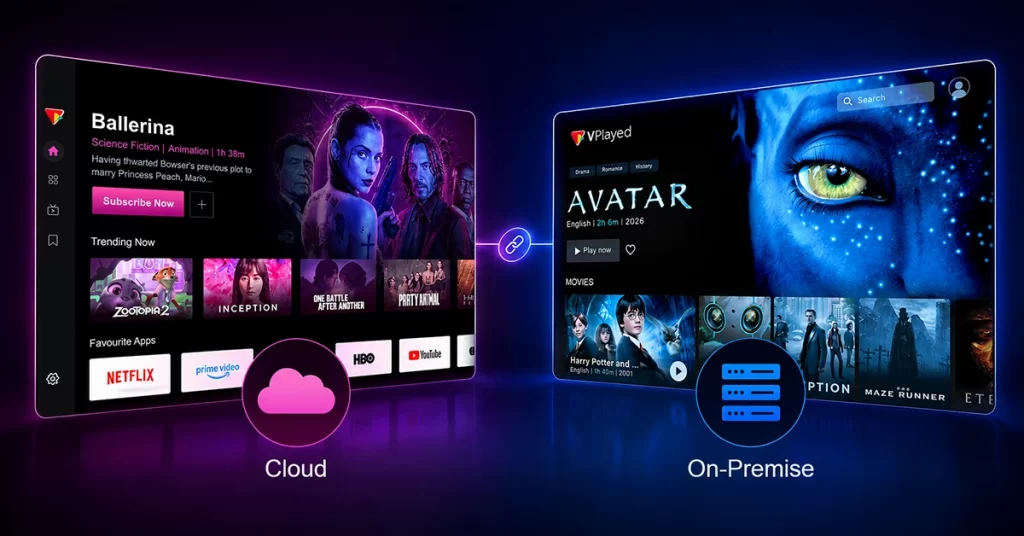
But video streaming businesses are starting to realize something important. The answer is not always one or the other, sometimes it is both. That is exactly why hybrid OTT infrastructure is becoming common across modern OTT platforms.
Hybrid OTT infrastructure combines cloud-based and on-premise environments within the same streaming ecosystem. Instead of running everything entirely on one deployment model, businesses distribute workloads based on operational priorities.
For example:
- Sensitive user data may remain on-premise
- Video delivery and scaling may happen through the cloud
- Live streaming workloads may use cloud elasticity
- Internal processing systems may stay within private infrastructure
In simple terms, businesses keep critical operations where they want deeper control, while using cloud environments for flexibility and scalability. Honestly, that balance makes a lot of sense.
Which OTT Infrastructure Is Right For Your Streaming Business?
By now, the answer is probably obvious. There is no universally “best” OTT infrastructure.
The better choice depends entirely on your business model, growth stage, technical capabilities, and long-term streaming goals.
Honestly, this is where businesses should stop following trends and start evaluating operational reality. Because infrastructure decisions that work perfectly for one OTT platform may become completely inefficient for another.
(i) Cloud-Based OTT Infrastructure
Cloud playout deployment is often the preferred choice for businesses prioritizing speed, flexibility, and faster market entry.
It works especially well for:
- OTT startups launching quickly
- Streaming platforms with unpredictable traffic
- Businesses expanding across multiple regions
- Teams without large internal infrastructure departments
If your priority is scaling quickly without managing physical servers internally, cloud infrastructure reduces a significant amount of operational complexity.
It also allows businesses to focus more on:
- Content growth
- Audience acquisition
- Monetization strategies
- Faster feature deployment
For many modern OTT platforms, that agility becomes a major competitive advantage.
(ii) On-Premise OTT Infrastructure
On-premise deployment is usually better suited for businesses that prioritize infrastructure control, compliance, and deeper customization.
This is common among:
- Enterprise OTT platforms
- Broadcasters
- Government-backed streaming systems
- Large media organizations
- Businesses handling sensitive user or content data
If your operations require strict governance, advanced workflow customization, or internal infrastructure ownership, on-premise environments provide more control.
But that control also comes with greater operational responsibility. This means businesses choosing this route need stronger internal technical resources and infrastructure management capabilities.
(iii) Hybrid OTT Infrastructure
Hybrid deployment is becoming the practical middle ground for many content owners.
It works well for OTT businesses that need:
- Cloud scalability during traffic spikes
- On-premise control for sensitive operations
- Greater deployment flexibility
- Multi-region infrastructure optimization
This approach is valuable for streaming businesses scaling at a fast pace while still maintaining operational control over critical systems.
Honestly, many enterprise OTT platforms are already moving in this direction. Because modern streaming infrastructure is no longer just about hosting videos. It is about building an ecosystem that can adapt as audience behavior, monetization strategies, and operational demands evolve.
Conclusion
At the end, the whole cloud vs on-premise OTT infrastructure debate is all about understanding which deployment model aligns better with your streaming business goals.
Cloud-based OTT platforms offer faster scalability, lower upfront investment, and easier infrastructure management. On-premise deployment provides deeper control, stronger customization capabilities, and greater infrastructure ownership.
Hybrid environments, meanwhile, are becoming the practical middle ground for businesses that need both flexibility and control. And honestly, that is where the OTT industry is heading.
Because modern video streaming businesses are built around scalability, monetization flexibility, audience expansion, and long-term operational control. That is why infrastructure decisions matter far more than they used to.
Deploy your OTT platform your way with VPlayed’s flexible cloud, on-premise, and hybrid infrastructure support.
- Request Demo Book a Live, Personalized Demo
- Contact Sales Reach Out to Our OTT Experts

Blogger & OTT Expert at VPlayed. Interested in digging deep into video streaming media tools, blog, discuss and share views on the legal OTT solution' & latest technologies tips, and tricks. Also passionate about photography loves to capture the pure essence of life.